

For many organisations, digital transformation has traditionally relied on bringing in external specialists to solve complex technology challenges.
While this approach can accelerate delivery, it can also create long-term contractor dependency, with critical knowledge leaving alongside contractors and making future change increasingly difficult to manage.
At Tecknuovo, our Zero Dependency® approach was designed to solve exactly this challenge: combining technology delivery and consultancy services with knowledge transfer so organisations build internal capability rather than long-term reliance on external suppliers.
As organisations seek more sustainable ways to modernise technology, that conversation is gathering momentum across both the public sector and private enterprise.
Tecknuovo’s recent work with HMRC Borders & Trade became part of that wider discussion, demonstrating how reducing contractor dependency can deliver measurable operational and financial benefits while attracting attention across national and trade media.
Zero Dependency in practice
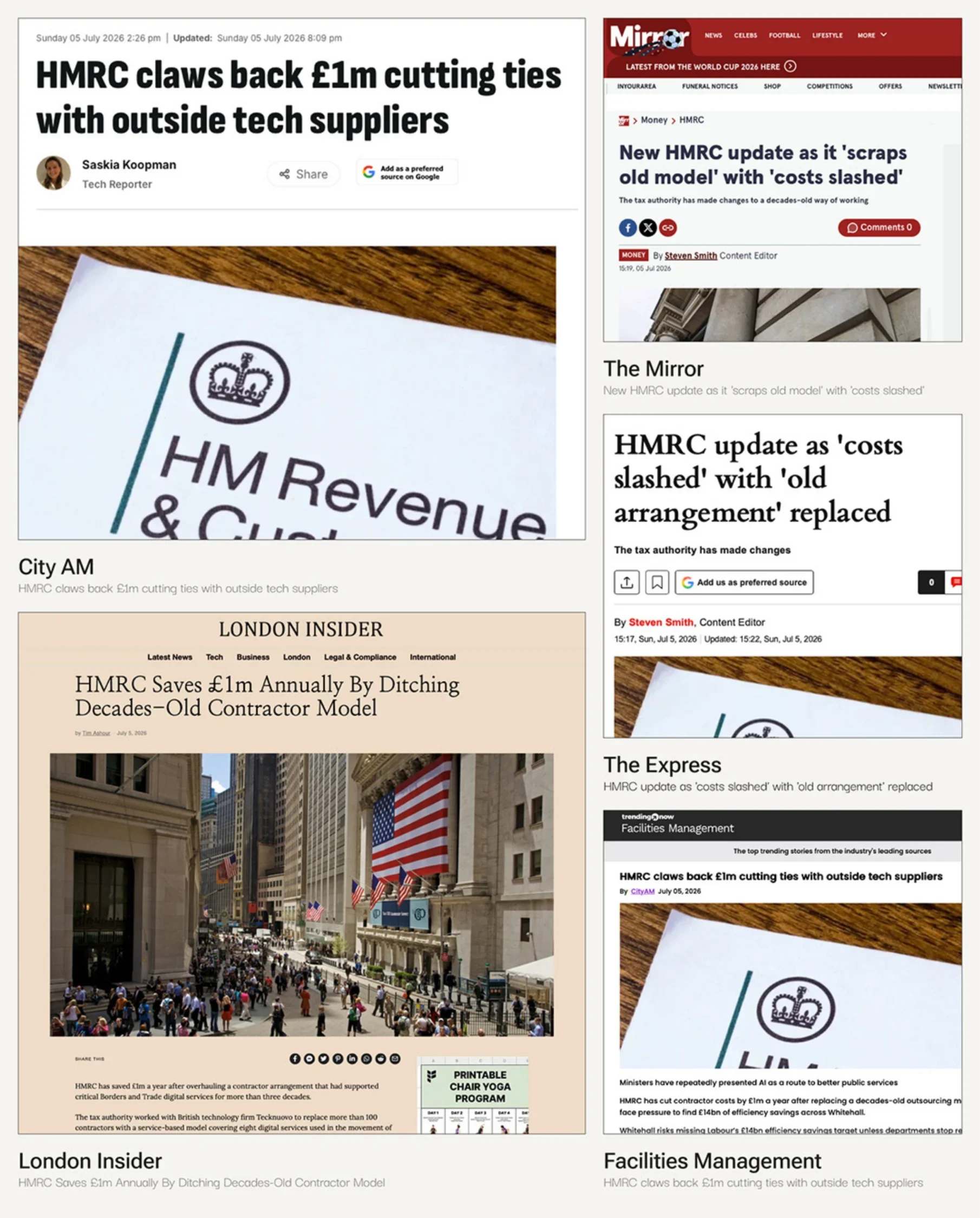
Our customer story, which explored how HMRC reduced long-term contractor dependency across its Borders & Trade services, was picked up by a number of national and industry publications, including City AM, The Mirror, Daily Express, London Insider and Facilities Management Now.
While each publication approached the story from a different perspective, they all centred on the same broader theme: reducing reliance on traditional contractor models whilst delivering measurable value for the public sector.
Coverage highlighted how HMRC transitioned from a decades-old contractor model to a managed service, generating a £1 million annual saving, reducing operating costs by 18%, and dramatically improving the speed at which new engineers could become productive.
As Katie Carruthers, Managing Director of Tecknuovo, said: “The issue isn’t external contractors or suppliers. There is, of course, a place for partnership. The issue is dependency.”
Why this matters
For us, the story isn’t simply about cost savings.
It’s about proving that organisations don’t have to choose between accessing specialist expertise and developing their own internal capability.
With the right delivery model, it’s possible to achieve both.
Rather than creating ongoing reliance on external suppliers, we work alongside client teams, embedding knowledge transfer, documenting systems and building capability throughout delivery so organisations are left stronger, more self-sufficient and better equipped for the future.
As more organisations face increasing pressure to modernise legacy technology whilst controlling costs, contractor dependency is becoming a strategic challenge rather than simply an operational one.
Ultimately, success isn’t just measured by what is delivered today, but by what organisations are able to achieve tomorrow. As Katie explains: “We think transformation should be measured by what’s left behind. Knowledge transfer should be a requirement, not an end-of-contract activity.”
Explore the coverage
To explore the wider conversation, read the coverage here:
- City AM – HMRC claws back £1m cutting ties with outside tech suppliers
- The Mirror – New HMRC update as it ‘scraps old model’ with ‘costs slashed’
- Daily Express – HMRC update as ‘costs slashed’ with ‘old arrangement’ replaced
- London Insider – HMRC Saves £1m Annually By Ditching Decades-Old Contractor Model
- Facilities Management Now – HMRC claws back £1m cutting ties with outside tech suppliers
Or explore the full HMRC Borders & Trade customer story to learn more about the transformation and how Zero Dependency® helped build lasting internal capability.