

Our Senior Delivery Lead Juan has created an unprecedented tool for optimising, tracking, and helping your project and organisation benefit from team learning: the Team Growth Radar. In this blog post, he explains how it works.
As a lifelong learner, I have always tried to unleash the collective genius of multidisciplinary and engineering teams by creating and advocating for learning opportunities for each team member.
I’ve always strongly believed that everyone one of us is a problem solver, but that we use different languages (like design or code) to create our solutions. That means we need to find ways to leverage these individual strengths as an opportunity for each team member to be a leader in their area of expertise, and to strengthen the team as a whole. For example, if a tester excels at creative thinking, then he/she is well placed to lead a creative session.
I’ve sometimes found it difficult to include growth opportunities in the flow of the work. Either because we did not have the time, or because we simply did not know how to build it into the project. Learning capacity is a constraint when commercial time commitments are aggressive. Everyone is heads down, and team/individual growth gets pushed to the side. On a similar note, when can an engineer learn and practice a new technology if they do not use it in the product they are working on? Maybe a learning opportunity exists during discovery.
Galvanising team learning
Team learning is most effective when:
- A target exists.
- New capabilities reinforce the organisation’s objectives.
- It is a continuous experience — not something you do ‘on the side’.
If a team member lacks the internal motivation to learn, learning with others is the perfect antidote. We need to bear in mind what each individual’s optimal path to learning could be, and use that to create more learning opportunities to support our team as a whole.
Tecknuovo’s Zero Dependency ® value proposition is the perfect foundation to empower continuous team learning. Zero Dependency® means that customer teams have the means to continue building lasting in-house capabilities through upskilling after we exit our engagement with the customer.
In the spirit of Zero Dependency® and Tecknuovo’s values of openness and connection, we want to unleash the first iteration of the Team Growth Radar (TGR): a tool for galvanising and optimising teams’ learning.
The Team Growth Radar: Tecknuovo’s ultimate tool for team learning
We designed the tool to give teams the learning opportunities they deserve by creating a simple, versatile, and visual tool to manage learning opportunities. The name, ‘TGR’, is of course an acronym, but also emulates the word ‘ToGetheR’, which speaks to the tool’s group learning intent nicely.
Using the TGR will help your team:
- Become more efficient and effective. This means learning the right thing at the right moment to then do the right thing at the right moment for the project.
- Continuously learn through a feedback loop by measuring progress. This will let them communicate outside the team and stay on top of opportunities for further learning within it.
- Create and sustain a healthy habit of learning by capturing and building from snapshots of their progress.
How does the Team Growth Radar work?
Below is an example of how we used the TGR for a customer project. I’ll use the example to explain how the tool works.
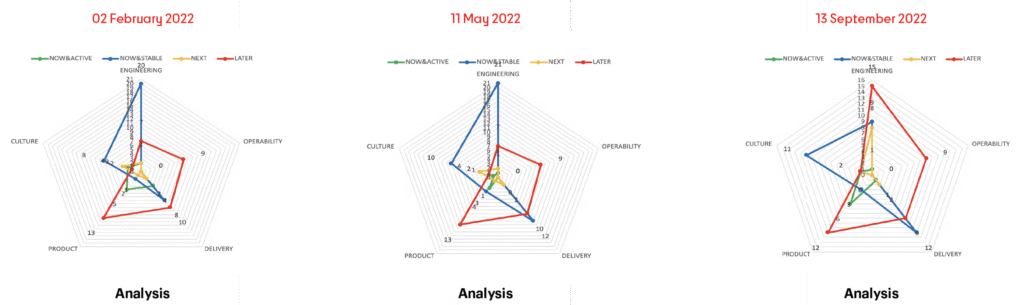
In this example, we’ve chosen to measure the team’s learning in five areas: engineering, operability, delivery, product, and culture.
The different colours represent different time horizons: Now (active), Now (stable), Next, and Later. The lines, then, represent how strong the team’s capabilities are against the criteria, what is being worked on currently, what is coming up next, later, and so on.
The radar shows where growth happened in the past, where it will happen next, and where there are any gaps in your team’s current collective skillset.
As for what you’re measuring, you can choose whatever is most relevant for your team and project objectives. That could be approaches (like integration testing or design sprints) or skills (like visual thinking or storytelling) — or why not a combination of the two. You can of course use fewer or more than six, but bear in mind that too many will make the radar harder to read and your overaching goals more diffuse!
For full instructions on how to use the TGR, head to the “Readme” tab in our downloadable Team Growth Radar template.
How can the Team Growth Radar tool help you optimise your team’s learning?
The TGR can help your teams accomplish three jobs more efficiently:
- Prioritising learning opportunities across the three horizons: Now/Next/Later.
- Analysing and synthesising progress through the radar’s visualisation function.
- Building learning habits with three-month “learning snapshots” to capture progress from a moment in time to analyse and reflect on.
Please note: this is not an MVP! It would also be presumptuous of us to call it a “product” at this stage. Instead, we classify it as an experiment, and we believe that simple, complete, and lovable iterations of this experiment will help us continue to learn as the tool itself develops and grows.