
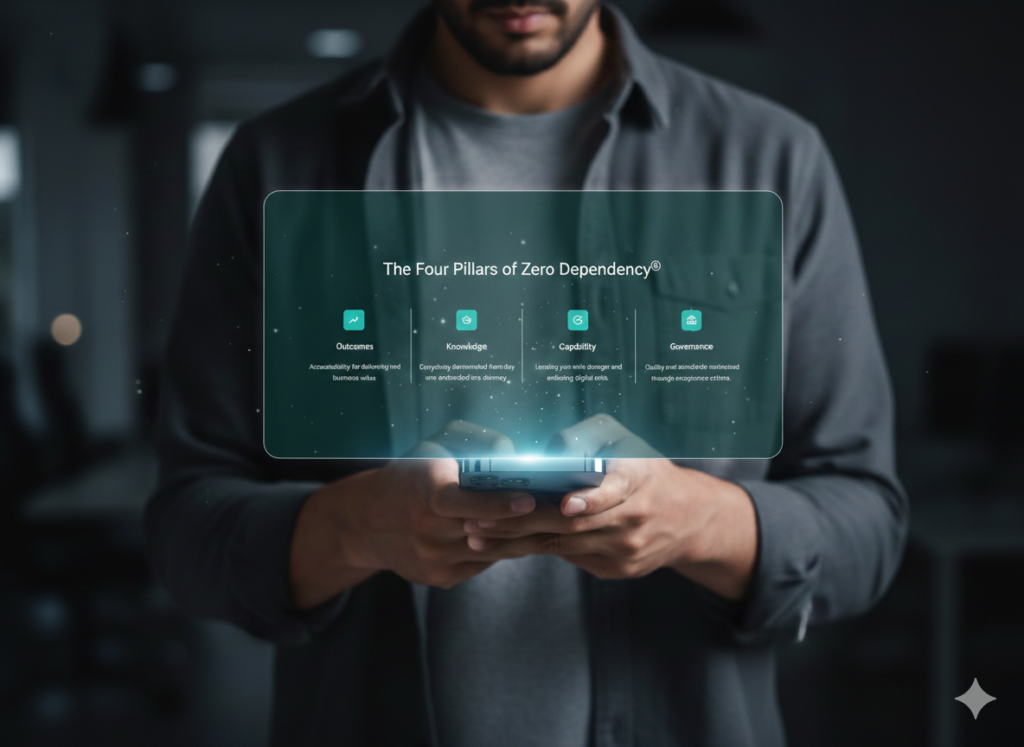
We developed the Zero Dependency framework through our work with four customers. They each had unique challenges but one wish in common: to independently manage and own the technology that powers their business success. This is the evolution of Zero Dependency.
Zero Dependency: the end of technology supplier lock-in
Yoox Net-a-Porter
We planted the seed that grew into our Zero Dependency framework during our project with luxury brands retailer Yoox Net-a-Porter (YNAP).
The challenge:
YNAP was seeing skyrocketing online sales after forming from a merger in 2015, and decided to build a new ecommerce platform to meet demand. They wanted to develop in-house knowledge of how to build, deliver and maintain the platform – all on a tight budget.
Addressing the challenge with Zero Dependency
We proposed a plan that would address YNAP’s requirements on in-house capability and budget all in one.
- We hired in a permanent team of junior engineers, selected for their aptitude, attitude, and right cultural fit.
- We upskilled the junior engineers by pairing them with our most senior technicians, who to mentored and upskilled them whilst building the platform together.
Figures
- Full in-house ownership of the platform after 18 months
- 70% of junior engineers promoted to senior roles within 18 months
Clear Channel
Zero Dependency evolved further through our work with out-of-home media company Clear Channel. We coached their teams to DevOps maturity, and built a proof of concept (POC) that would shape their supplier-independent transformation roadmap.
The challenge
We had previously helped Clear Channel’s UK team to modernise their operations through a microservices platform. The international entity was keen to catch up, and enlisted our help to develop DevOps maturity and a microservices architecture.
Addressing the Challenge with Zero Dependency
To introduce Clear Channel to DevOps, we ran a maturity assessment to evaluate their organisational structure, ways of working, tech stack and technical capabilities.
- This produced a set of actionable processes that they could independently implement to enable a DevOps-friendly culture.
- Our engineers built a proof of concept for a microservices architecture that helped Clear Channel radically modernise its operations.
- In parallel, our teams coached Clear Channel’s in-house teams on the technologies and ways of working that we leveraged to build the solutions.
Figures
- Microservices architecture replicated across the business
- Zero Dependency after eight weeks of engagement
HMRC
We built a testing framework for HMRC, upskilled their in-house teams on running and maintaining it, and ensured lasting value by training them to replicate the technology across the organisation.
The Challenge
HMRC was building a greenfield import control system to handle an increase in customs declarations to 90 million per year post-Brexit. This called for a reliable safety and security system with an independent, automated testing framework to form its backbone.
Addressing the challenge with Zero Dependency
- We implemented an API automation testing framework encompassing test management, component testing, performance testing, systems integration testing, operational acceptance testing, and end-to-end testing.
- Our teams upskilled our customer’s staff on agile ways of working, ensuring they could use them to understand the project’s requirements and success criteria.
- We documented our work in depth, and ran a series of sessions to ensure a complete knowledge transfer to the in-house teams.
Figures
- Story points delivery sped up by 25%
- Three million declarations successfully processed within a week
Thames Water
With Thames Water, we rolled out the fully-fledged version of Zero Dependency. We liberated them from lock-in with a previous legacy SI supplier and helped them build, own, and manage their new in-house version.
The challenge
Thames Water wanted to build an in-house SI system as an integral part of their digital transformation. They needed a partner with the technical expertise to migrate their workloads from their legacy platforms to the cloud. And they wanted to avoid future lock-in with a technology vendor by developing the in-house skills to own and manage their new cloud-based solutions.
Addressing the challenge with Zero Dependency
- We built a team to design the new cloud-based platform and to lift and shift Thames Water’s legacy applications.
- Our most senior engineers mentored them through an intensive 12-month upskilling programme, ensuring they were fully capable of maintaining the new platform.
Figures
- Zero Dependency on us after the end of the project
- Thames Water’s journey to cloud platforms accelerated by 25%